From Lab Insight to Lived Reality: How GraspAgain Is Bridging Technology and Everyday Life
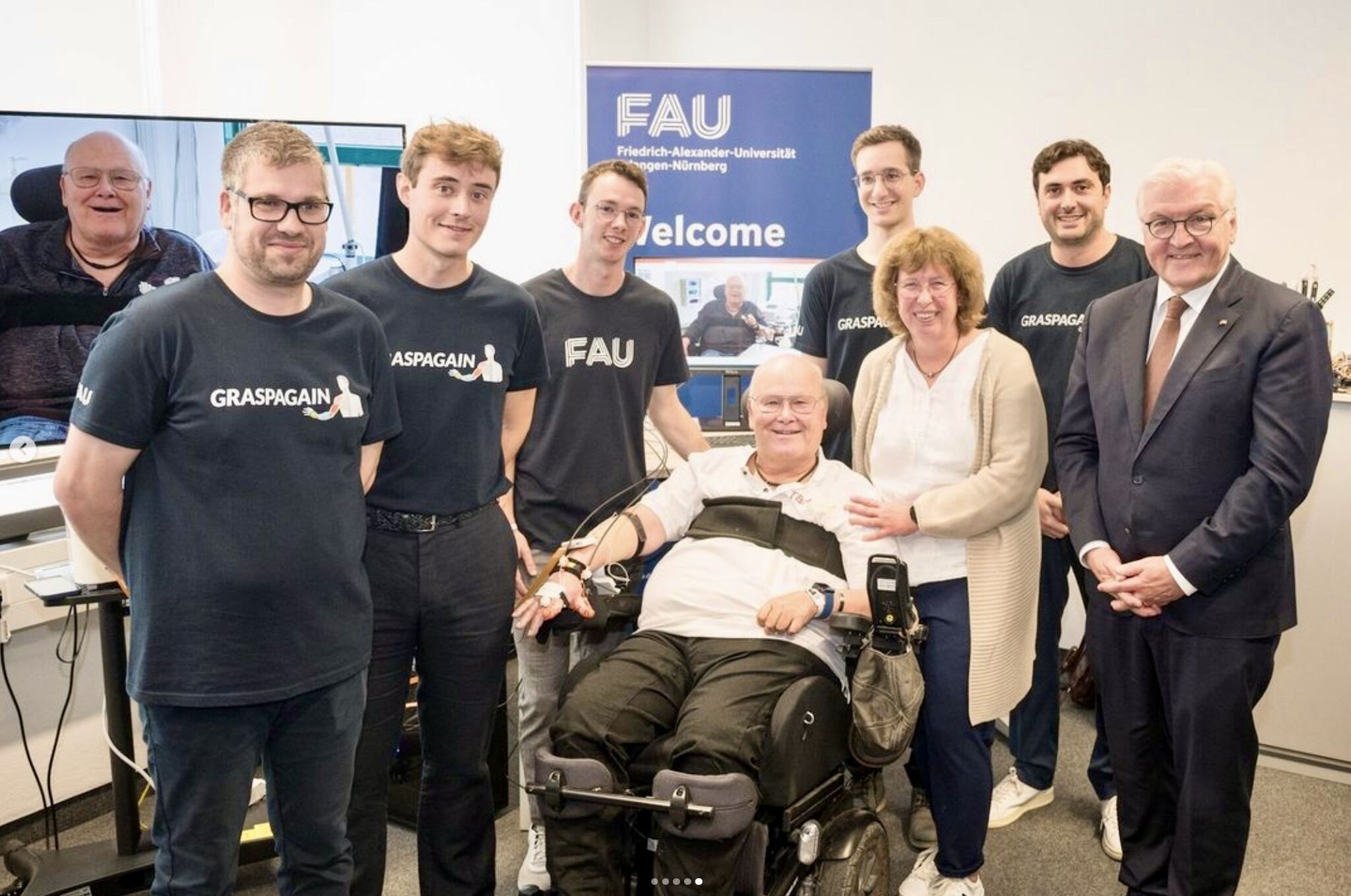
GraspAgain entered the Praxis SCI Incubate Program with a strong technical foundation already in place. The team had built a unique AI-enabled orthosis capable of decoding natural movement intent from forearm signals and restoring grasp in an intuitive way.
In the lab, that can feel like the finish line. In the real world, it is the starting point. One point the program’s early conversations made clear was that technical success alone does not translate into real-world adoption.
Direct, unfiltered engagements with people with lived experience (PLEX) of spinal cord injury (SCI), clinicians, and mentors in the Praxis ecosystem went beyond whether the device could restore grasp to whether it could realistically be used day to day. Functional performance still mattered, but it was weighed alongside comfort, durability, key use cases, and the ability to use the device without assistance. The team began to see a gap between optimizing performance in the lab and meeting the conditions required for real-world adoption.
Independence as the Baseline, not a Feature
Across weekly sessions with the Praxis PLEX community, clinicians, and mentors, one requirement kept resurfacing: users needed to put the device on and take it off independently and efficiently. This was not a minor usability tweak; it was a gatekeeper for adoption.
“The biggest shift that we had to make was understanding the way that people need to interact with [the device] on their own,” said Dominik Braun, co-founder of GraspAgain. “While the functionality is there… it also really needs to be a device that’s comfortable that you would like to wear.”
That insight guided concrete changes. The team revisited how the system comes together, placing new emphasis on the coupling mechanism so it could be engaged and disengaged more easily by the user. At the same time, they prioritized comfort and wearability, revisiting materials, production methods, and padding to reduce pressure points. The simple yet demanding goal was to build a device that works well and feels reasonable to live with.
Direct, unfiltered engagement with people with lived experience of spinal cord injury, clinicians, and mentors within the Praxis ecosystem shifted the focus beyond whether the device could restore grasp to whether it could be realistically integrated into daily life.
The Path to Scale: Start with Focused, High-Impact Use Cases
Another shift was strategic rather than mechanical. What began as an all-day device intended to serve a wide range of injury levels evolved, through PLEX engagement, into a clearer understanding of where restored grasp delivers the greatest independence for different users. Instead of attempting to address every grasp scenario at once, the team focused on identifying two or three everyday moments, across injury levels, that needed to work flawlessly to have the most impact.
That clarity reshaped how GraspAgain validated the product. Testing was shifted earlier, and environments more closely reflected real-life conditions, including rehabilitation spaces designed like apartments, where everyday tasks could be practiced and observed. At the same time, conversations with clinicians and mentors broadened the team’s perspective beyond the primary user, surfacing additional clinical use cases across the SCI care continuum and offering insight into how new tools are evaluated and adopted within rehabilitation and hospital settings.
Moving Forward with Clarity and Confidence
Today, GraspAgain is entering its next phase with a clearer product and a more focused roadmap. Upcoming studies planned for early 2026 will involve a small initial cohort, using participant feedback to finalize design decisions while continuing to refine comfort and ease of interaction.
The hardware itself reflects insights gained from the program. The system is becoming more integrated and reliable, with a streamlined, purpose-built setup that reduces interference, embedded electronics that remove the need for an external laptop, and a small on-device display that lets users adjust settings and retrain the AI directly.
What Praxis ultimately unlocked was not a change in ambition, but confidence through de-risking. By pressure-testing assumptions early, the team reduced key risks around user fit, daily usability, and clinical relevance. The result is a tighter product vision and a clearer path from promising prototypes to something people can realistically use and trust in their everyday lives.
About GraspAgain
GraspAgain aims to restore hand function in people with neuromuscular impairments through intelligent neuroorthosis. The system comprises two main components: a non-invasive brain-machine interface and advanced mechatronics. The brain-machine interface utilizes artificial intelligence to decode biosignals measured from the forearm muscles of the paralyzed hand, accurately interpreting the intended movement. This decoded intention is then mapped to the actuation unit of the orthosis, which executes the corresponding movement.
To facilitate daily use, the neuroorthosis consists of two parts: a lightweight hand module and a separate actuation unit. The hand module weighs only 100 grams and fits over the paralyzed hand, while the actuation unit can be easily attached or detached via a smart coupling mechanism as needed. The control system is cable-driven and anatomically inspired; similar to muscles, the motors pull and release “tendons” to generate mechanical movement. Their interdisciplinary team, with extensive expertise, is confident that GraspAgain represents a revolutionary product that will empower people with hand impairments to lead more independent lives.
About the Praxis SCI Incubate Program
The Praxis Spinal Cord Institute’s Incubate Program is a four-month Program geared towards prototype stage projects with innovation to transform the lives of people with spinal cord injury (SCI). The Program provides targeted end-user product validation, research, mentorship support, tailored mentorship, expert guidance, and access to their commercialization network.