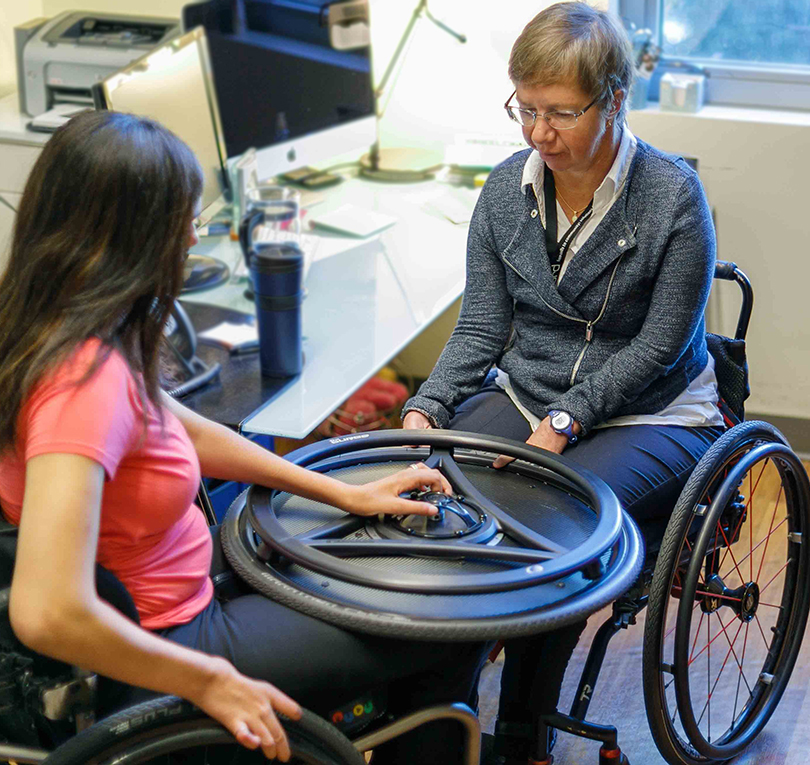
Care Possible is a technology enabled social enterprise that helps families and individuals find, schedule and manage trusted and verified in-home care providers through an easy-to-use web app. An initiative of Manitoba Possible, the Care Possible platform simplifies key aspects of self-managed and family-managed care, including provider discovery, scheduling, payments and paperwork. By making personalized care easier to access and coordinate, Care Possible aims to give individuals greater choice and control over how their care is delivered.
Visit their website

Sielo Robotics is developing an AI-assisted robotic arm that mounts to power wheelchairs. The device is designed to help people with limited upper-limb mobility complete everyday activities such as eating, drinking, retrieving objects and opening doors independently. Developed with input from power-chair users and occupational therapists and rehabilitation professionals, Sielo Robotics aims to create practical, user-centred assistive technology that gives people greater freedom in everyday life and reduces their need for assistance.
Visit their website

RISE NeuroProsthetics is developing the next generation of implantable neurostimulation devices for people living with spinal cord injury. Its technology uses ultra-thin, high-channel microelectrode arrays designed to precisely stimulate neural circuits within the spinal cord. Bringing together neuroscience, engineering and neurosurgery, RISE NeuroProsthetics is advancing its technology through preclinical validation toward clinical translation.
Visit their website

TWOO Medical is developing a novel applicator designed to help people with spinal cord injury and other neurological conditions manage neurogenic bowel dysfunction more independently, reliably and with greater dignity. By addressing an often time-consuming and unpredictable aspect of daily life, the solution aims to reduce the need for care provider assistance and give individuals greater control over their bowel care routines. TWOO Medical is working toward a practical, user-centred solution designed to work faster and more predictably while supporting greater independence and quality of life.