This is the breadcrumbs block. Breadcrumb will populate on actual page.
Building the Bridge: A Conversation on What SCI Innovation Actually Takes
Thought controlled walking. Neural implants. Headlines that used to read like science fiction are now showing up in clinical trials. The question is no longer whether the science is real. It is whether it reaches the person living with a spinal cord injury.
That bridge, between cutting edge neuroscience and lived reality, is what Praxis Spinal Cord Institute has spent over fifteen years building.
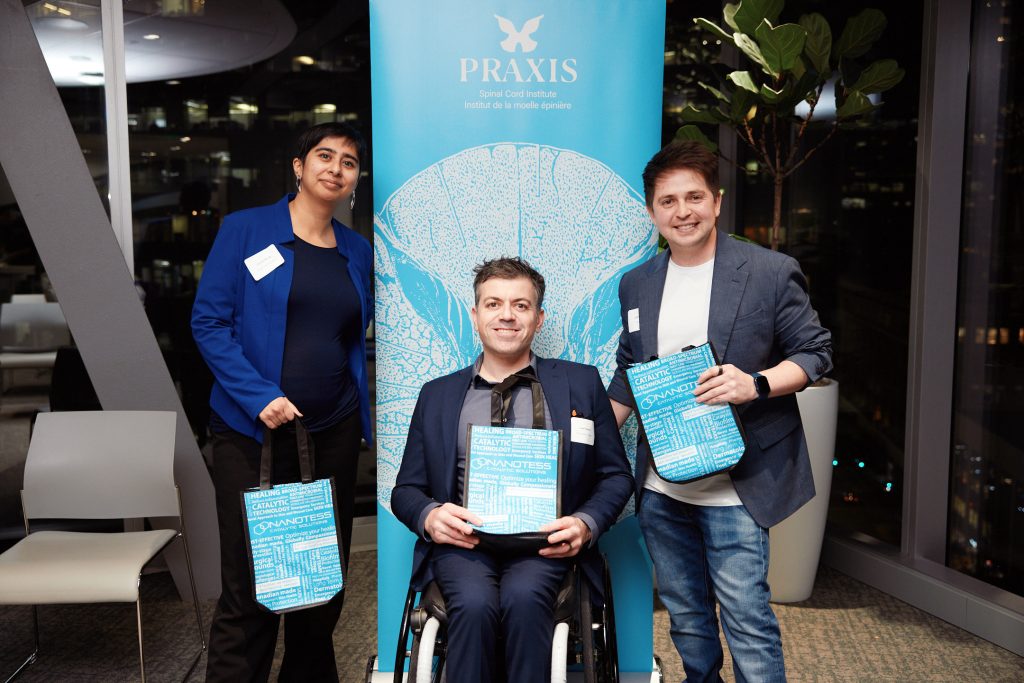
At the 2nd Annual SCI Innovation Showcase, three voices came together to talk about what it actually takes to move neurological health innovation from the lab to the people who need it:
- Joel Dembe, Disability Advocate and Former Paralympian
- Julian Mulia, Co-founder and COO, NanoTess Inc
- Arushi Raina, Chief Investment Officer, Praxis NeuroVentures and Director of Innovation, Praxis
Three ideas stood out.
The infrastructure behind the work
Over 45 startups supported. More than $260M in follow-on capital raised. 18 products on the international market. A national registry of over 15,000 individuals living with SCI. Five of the world’s top acute SCI researchers based right here in Canada.
1. Where founders earn their unfair advantage
Most accelerators offer mentorship, office space, and a few customer introductions. Praxis offers something almost no other program in the world can match: between 80 and 150 hours of structured, in depth contact with people living with spinal cord injuries, before a startup files for regulatory approval or writes a serious investor deck.
As Arushi put it, most healthtech founders spend months trying to access a single patient interview. By the time they pitch a VC, they have talked to one person, maybe two. Praxis closes that gap by an order of magnitude.
Insight is the only durable competitive advantage in healthtech. That is what Praxis actually sells.
2. SCI is not a niche. It is the proving ground.
A common pushback is that SCI is too small a market to anchor a serious commercialization platform. The numbers tell a different story.
Spinal cord injury sits at the intersection of chronic pain, mobility, pressure injury, bladder and bowel function, and mental health. Each is a multi-billion dollar market. What works in SCI translates directly to stroke, multiple sclerosis, traumatic brain injury, and Canada’s aging population.
If Formula One is where automotive technology gets stress tested before it lands in family sedans, SCI is where neurological health innovation gets stress tested before it scales into the trillion-dollar global health market.
3. The community is the co-founder
Julian shared the oven mitt test. Early in NanoTess’s design process, members of the Praxis SCI community challenged the team to apply their own product while wearing oven mitts, simulating limited hand dexterity. The original prototype failed.
That single insight changed the product. NanoSALV, the company’s flagship wound care treatment, is now a gel rather than a patch, because no wound is square and no one with a hand injury wants to peel adhesive backing one handed.
Inclusive design is not an ethics line item. It is the fastest known route to product market fit.
Praxis Alum NanoTess as proof point
NanoSALV is now available across 3,600 Canadian hospitals and is one of only three technologies in history added to the Alberta drug formulary as a medical device. As Arushi noted, the technology is now improving the lives of one in six Albertans in hospitals by healing life threatening wounds. Manufacturing was built in partnership with the Department of National Defence, capacity that proved its value during covid era supply chain disruptions.
NanoTess is also one of six early stage investments made through Praxis NeuroVentures, the institute’s venture arm, which writes earlier checks than mainstream VCs can, backed by clinical insight, regulatory fluency, and lived experience signal.
Why this matters now
Canada has a long history of inventing things and watching them commercialize elsewhere. Insulin. mRNA technology. The opportunity in front of us is to break that pattern in neurological health, where insight, capital, and community can move together.
To stay connected, explore collaboration opportunities, or learn more about our innovation initiatives, reach out at innovation@praxisinstitute.org.
About Praxis Innovation Program
At Praxis, we focus on advancing SCI research innovations out of the laboratory and into the marketplace where they can benefit people living with SCI. We connect a world-class team of SCI experts and health entrepreneurs with targeted resources to support ventures across different stages of development.